Real vs. Replica: The Ultimate Guide to Spotting a Fake Parker or Chiswell Piece
The Australian Mid-Century Modern (MCM) revival is in full swing. We all want that sleek, warm, “Mad Men” aesthetic in our living rooms.
But this boom has created a dangerous landscape for buyers.
Scroll through Facebook Marketplace or Gumtree, and you will see hundreds of listings for “Parker Style” chairs or “Chiswell Style” sideboards. Sometimes, sellers are honest about them being modern replicas. Other times, they are trying to pass off a cheap, modern import as a piece of valuable Australian design history—with a price tag to match.
If you are going to invest hundreds (or thousands) of dollars in vintage furniture, you need to know what you are looking at.
At Timber & Time, our vintage sellers are vetted for authenticity. But we believe an educated buyer is the best kind of buyer. Here is your detective’s guide to separating the real deal from the cheap imitation.
Why Does Authenticity Matter?
Is it just design snobbery? Absolutely not. There are three practical reasons why you should care if it’s a real Parker or Chiswell:
- Build Quality: Parker and Chiswell built furniture to last generations. They used quality timbers (like solid teak frames and thick veneers) and superior joinery. Replicas are often made of cheap, lightweight tropical woods, stained dark, and held together with Allen key bolts that loosen over time.
- Investment Value: An authentic mid-century piece is an asset. It will hold its value and likely appreciate. A modern replica will lose 50% of its value the moment you take it home.
- The History: You are buying a slice of Australian manufacturing history. A replica is just more future landfill.
The Golden Rule: “Parker Style” = Not Parker
Before we get into the details, let’s address the biggest red flag.
If a listing says “Parker Style,” “Danish Style,” or “Retro Style,” it is almost certainly a modern reproduction or a vintage piece from a lesser-known, lower-quality manufacturer.
Sellers use these keywords to capture your search traffic. Unless they explicitly state “Authentic Parker,” assume it is not.
4 Clues to Look For (The General Checklist)
Before zooming in on specific brands, look at the overall piece.
1. The Patina (The Look of Age)
A chair built in 1965 should not look brand new. Even a restored piece should have a certain warmth and depth to the timber that only comes with 60 years of oxidation and sunlight.
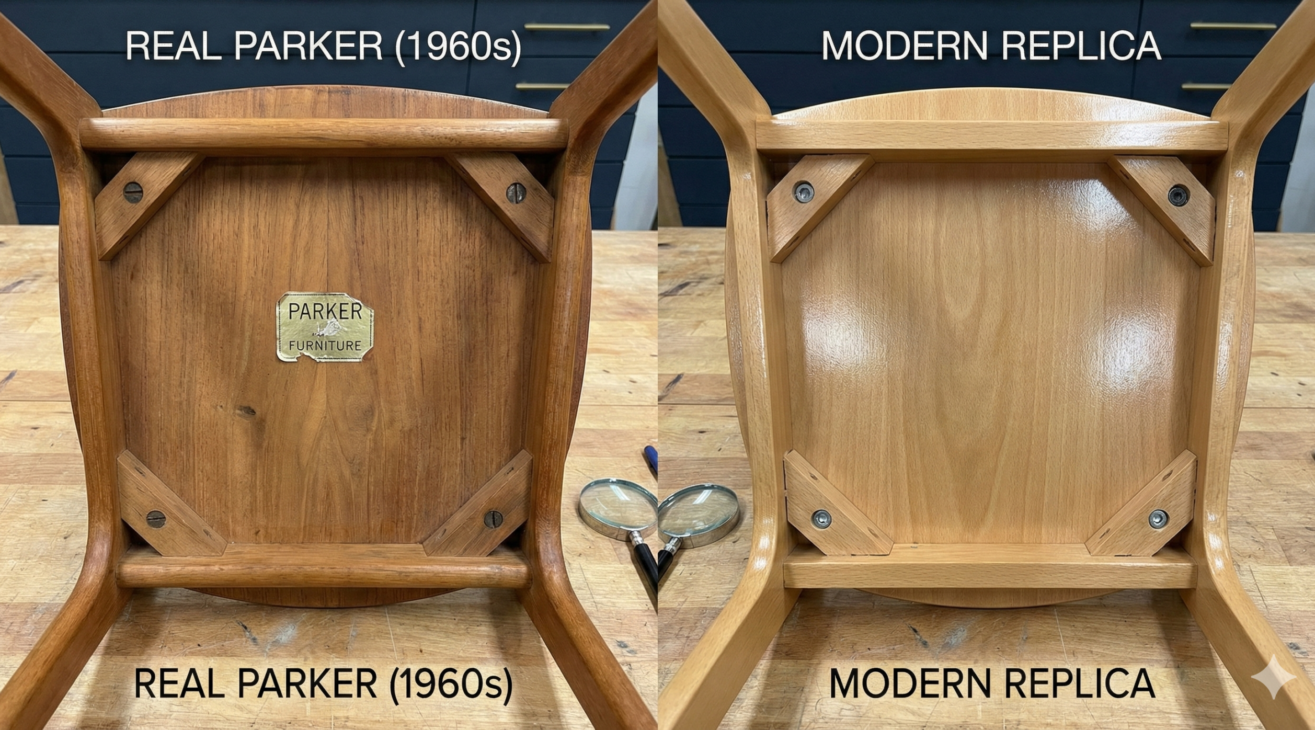
- The Fake: Looks flat, suspiciously uniform in colour, and often has a “plastic” looking shiny lacquer.
- The Real Deal: Has subtle variations in colour, perhaps slight darkening where hands have touched the arms for decades, and a “soft” sheen rather than a high gloss.
2. The Weight Test
Australian MCM furniture feels substantial.
- The Fake: Often feels surprisingly light because it uses cheaper, less dense timber varieties.
- The Real Deal: If you pick up a genuine Parker dining chair, it feels solid and grounded.
3. The Hardware
Flip the table or chair over. Look at how it’s put together.
- The Fake: Modern Phillips head screws or, worse, hexagonal Allen key bolts visible on the underside.
- The Real Deal: Vintage pieces generally used flathead screws. Better yet, high-end joinery meant screws were rarely used at all on chair frames—it was all mortise and tenon joints.
4. The Smell Test
Seriously, smell inside a drawer or underneath the seat.
- The Fake: Smells like fresh lacquer, chemicals, or new plywood.
- The Real Deal: Smells dusty, waxy, and like old, dry timber. It’s the smell of grandma’s house.
Brand Deep Dive: Spotting a Parker
Parker Furniture is the benchmark for Australian MCM. They were famous for adapting Danish design principles for the Australian market using high-quality materials.
- The Labels: Parker used several labels over the decades. The earliest (50s/60s) were often a small red and gold sticker. Later pieces had foil labels. Caution: Labels fall off. A missing label doesn’t mean it’s fake, but a present label is a good start.
- The Timber: Parker is famous for using Teak. Chair frames were usually solid teak. Sideboards were teak veneer over a solid core. The timber should have a rich, warm, golden-brown glow.
- The Joinery: Look at where the leg meets the seat of a chair. Parker joinery was seamless and smooth. You shouldn’t see gaps, filler, or crude screws. The curves should feel organic and fluid to the touch.
Brand Deep Dive: Spotting a Chiswell
Chiswell was another giant of the era, known for fantastic quality and slightly more intricate designs than Parker.
- The Labels: Usually a gold foil rectangular label found inside a top drawer or underneath dining chairs.
- The Handles: This is a major tell. Chiswell often used very distinct, sculptural timber handles integrated into the doors or drawers (like their famous “wave” handle). Replicas rarely bother to copy these complex handle shapes.
- Veneer Matching: Chiswell were masters of veneer. Look at the front of a sideboard. The grain pattern should flow continuously across the doors and drawers. If the grain pattern abruptly stops and restarts between drawers, it’s likely a cheaper imitation.
The Final Word
The best way to learn is to look at the real thing. Visit reputable vintage shops. Feel the weight of the wood, run your hands over the joints, and smell the drawers. Once you know the feeling of quality, the fakes become obvious.
Or, skip the detective work and shop with confidence.
At Timber & Time, our “Vintage Finds” section is curated by sellers who know their stuff. We do the vetting so you can focus on finding the perfect piece for your home.
[Shop Authentic Vintage Furniture]