The “Brown Furniture” Revival: 5 Underrated Antique Styles to Buy Before Prices Boom
For the last fifteen years, the vintage furniture market has had a singular obsession: Mid-Century Modern (MCM).
We all fell in love with the sleek teak lines of Parker sideboards and Danish armchairs. But that obsession has driven prices sky-high. What used to be a $200 op-shop find is now a $2,500 investment piece on Instagram.
While everyone is fighting over the last remaining 1960s pieces, a massive segment of the market has been ignored. The industry calls it “Brown Furniture.”
We are talking about heavy, solid, dark timber pieces from the Victorian, Edwardian, and Art Deco periods. For decades, these have been dismissed as “fusty,” “grandma-ish,” or too imposing for modern homes.
But the tide is turning.
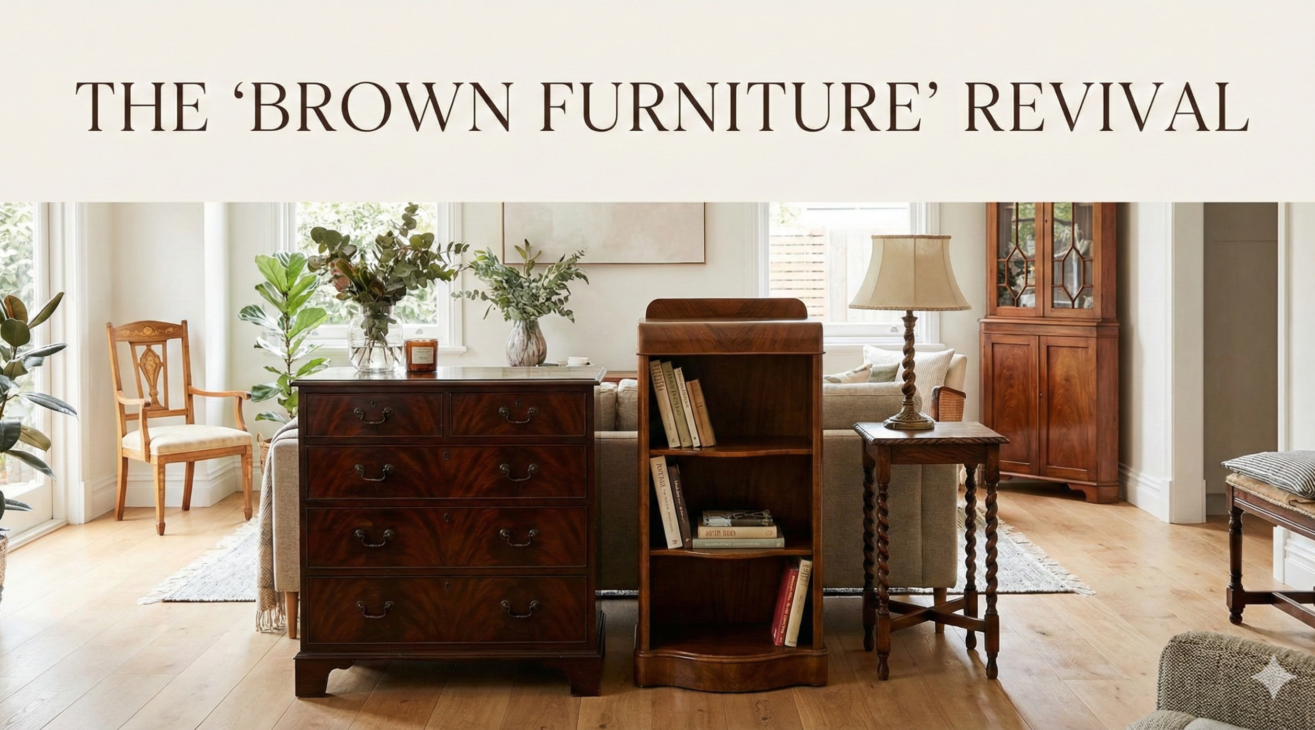
Interior designers are moving toward maximalism, rich textures, and historical soul. Suddenly, that heavy mahogany chest doesn’t look dated; it looks like a statement piece that anchors a room.
The best part? Because they have been uncool for so long, their current prices are ridiculously low compared to the quality of craftsmanship. You can buy a solid mahogany chest of drawers handmade in 1890 for less than a chipboard flatpack from IKEA.
It won’t stay this way. Here are 5 underrated antique styles that are currently sleeping giants in the Australian market.
1. The Edwardian “Sheraton Revival” (approx. 1901–1910)
If Victorian furniture is heavy and dark, Edwardian is its lighter, more elegant cousin.
Emerging after Queen Victoria died, this era rejected heaviness in favour of lighter timbers and refined shapes, often inspired by 18th-century designer Thomas Sheraton.
- The Vibe: Elegant, practical, and sophisticated.
- What to look for: Tapered legs (getting thinner towards the foot), satinwood or lighter mahogany, and delicate inlaid lines of contrasting timber stringing on drawer fronts.
- Why buy it now: Edwardian pieces blend beautifully with modern interiors because they aren’t overly bulky. An Edwardian nursing chair or a slender inlay desk looks incredible in a contemporary corner.
2. Australian Federation (approx. 1890–1915)
This is our own backyard history. Coinciding with Australia becoming a nation, this style was all about patriotic pride and using native materials.
- The Vibe: Sturdy, sensible, proud, and uniquely Australian.
- What to look for: The holy grail is Australian Red Cedar, a stunning, lightweight timber with a deep crimson colour that is now commercially unavailable. Also look for Kauri Pine and motifs featuring native flora (like flannel flowers) carved into panels.
- Why buy it now: These pieces were built to survive the Australian climate. A solid Red Cedar Federation chest of drawers is a piece of national history that is currently absurdly undervalued.
3. Art Deco “Waterfall” Styles (approx. 1920s–1940s)
While high-end French Art Deco has always been expensive, the more common “everyday” Deco produced in Australia during the depression era is still a bargain.
- The Vibe: Glamorous jazz-age sleekness mixed with industrial curves.
- What to look for: The “Waterfall” edge. This is where the timber veneer on the top front edge of a dresser or wardrobe curves down in one continuous sweep, rather than having a sharp corner. Also look for stunning walnut veneers and original Bakelite (early plastic) handles.
- Why buy it now: The curves of this era are incredibly soothing in a modern home. A waterfall tallboy is practical storage that looks like a sculpture.
4. Victorian Chests & Cabinets (approx. 1837–1901)
We are going to be specific here. We aren’t suggesting you buy a gargantuan Victorian wardrobe that you can’t fit through your door. We are talking about waist-height storage.
- The Vibe: Serious gravitas, deep colours, and unbreakable construction.
- What to look for: “Flame” mahogany veneers (where the grain looks like flickering fire), rounded “bun” feet, and drawers that slide perfectly after 150 years because they were hand-dovetailed by a master craftsman.
- Why buy it now: A dark Victorian chest of drawers acts as an incredible anchor in a white, minimalist room. The contrast is what makes it work. The quality-for-price ratio here is currently the best in the entire furniture market.
5. Jacobean Revival / “Barley Twist” (1920s–1930s Revival)
This style is the definition of “character.” In the 1920s, there was a nostalgic revival of the heavy oak styles of the 1600s.
- The Vibe: Old English pub, theatrical, and highly textured.
- What to look for: The iconic “Barley Twist” leg. These look like huge corkscrews turned on a lathe. Usually found on side tables, dining tables, and sideboards in dark stained oak.
- Why buy it now: These are polarizing pieces—you love them or hate them. But in a modern setting, a single barley-twist side table is fascinating. It adds instant texture and history that a plain modern box cannot compete with.
The Investment Perspective
Right now, you can buy these styles for pennies on the dollar because the demand hasn’t caught up to the supply.
But as sustainability becomes more important, people are realizing that the greenest furniture is the stuff that already exists. Furthermore, the skills required to make these pieces—the hand carving, the complex veneering, the french polishing—are becoming rarer and more expensive to replicate new.
When you buy “Brown Furniture,” you are buying the bottom of the market. The only way is up.
Ready to hunt for a future classic? Explore our curated selection of pre-mid-century treasures.
[Shop Antique & Heritage Furniture]