What is “Recycled Timber” Really? (And Why Does It Cost More Than New Wood?)
There is a common misconception in the furniture world.
It goes something like this: “If the timber is second-hand, shouldn’t it be cheaper? You just found it in an old building, right?”
We get it. In most industries, “used” means “discounted.” But in the world of custom Australian furniture, Recycled Timber is the premium choice. It often costs more per linear metre than brand new timber straight from the mill.
Why? Because you aren’t paying for the wood; you are paying for the history, the stability, and the back-breaking labour required to save it.
At Timber & Time, we champion the makers who do the hard work of rescuing this material. Here is the truth about what recycled timber actually is, and why it is worth every cent.
Myth-Busting: It’s Not Old Pallets
First, let’s clear up the biggest myth. When high-end furniture makers talk about “Recycled Timber,” they are not talking about pine shipping pallets found behind a warehouse.
They are talking about structural hardwoods sourced from Australia’s industrial history.
- Roof Trusses: From demolished 1920s Melbourne wool stores.
- Floor Joists: From cloudy post-war cottages in Queensland.
- Wharf Beams: Massive pylons from old Sydney ferry terminals.
- Railway Sleepers: The heavy Ironbark that held up the tracks crossing the Nullarbor.
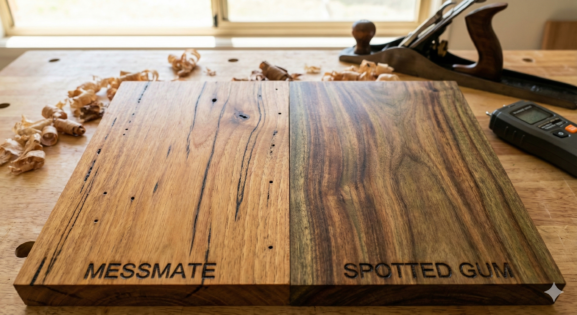
This is dense, heavy, old-growth Eucalypt—Messmate, Ironbark, Spotted Gum, and Blackbutt—that was harvested 50 to 100 years ago. You literally cannot buy new timber of this density anymore because the trees don’t exist in commercial forestry.
The “Hidden Tax”: Why It Costs More
If the wood is free (or cheap) to salvage, where does the cost come from?
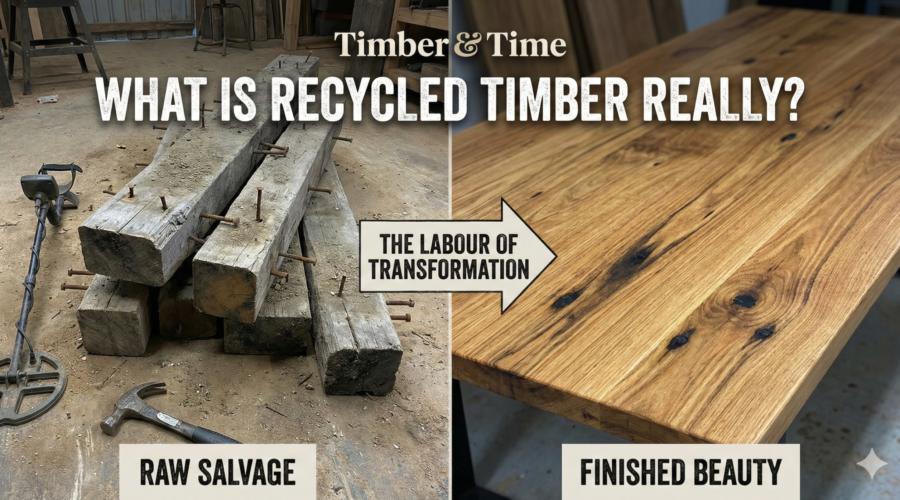
1. The “De-Nailing” Nightmare Before a maker can even think about making a table, they have to make the wood safe. Old timber is full of rusty nails, bolts, and screws. If a maker runs a piece of wood with a hidden nail through their thicknesser machine, it will instantly destroy the blades (costing hundreds of dollars to replace) and potentially injure the maker.
- The Process: Every single beam must be swept with a metal detector. Every nail must be pulled out by hand. It is slow, manual, and exhausting work.
2. The High “Wastage” Rate When you buy new timber, it is perfect. You use 100% of it. When a maker buys a pack of recycled timber, they might lose 30-40% of it during processing.
- They have to cut off the rotten ends.
- They have to plane down the grey, weathered exterior to reveal the honey-coloured wood inside.
- They often find cracks or splits that make parts of the board unusable. To get one perfect table, they often have to buy enough wood for two.
3. It destroys tools Recycled Australian hardwood is hard. After 80 years of air-drying in a roof, it becomes like stone. It blunts saw blades and chisels much faster than new “green” timber, increasing the overheads for the workshop.
So, Why Should You Pay For It?
If it’s so hard to work with, why do makers love it? And why do homeowners covet it?
1. Unbeatable Stability (The “Seasoning” Factor) New wood is full of moisture. Even kiln-dried new timber can move, shrink, and cup as it adjusts to your home’s air conditioning. Recycled timber has been “seasoning” for a century. It has done all the moving it is ever going to do. It is incredibly stable, meaning your table is far less likely to warp over time.
2. The “Oxide” Aesthetic This is the feature you can’t fake. When a nail sits in timber for 50 years, it reacts with the tannins in the wood, creating a black ink-like stain known as an “oxide mark.” When the nail is removed and the wood is sanded, you are left with these stunning black bolt holes and streaks that tell the story of the timber’s past life.
3. True Sustainability This is the ultimate guilt-free purchase. No new trees were cut down to make your dining table. You are sequestering carbon that was harvested a lifetime ago and preventing valuable material from ending up in landfill.
The Bottom Line
When you look at the price tag of a recycled timber dining table, remember what you are buying.
You aren’t just buying wood. You are buying a piece of the Sydney Harbour Bridge, or a beam from a historic shearing shed. You are paying for the hours spent pulling rusty nails by hand so that this history can be preserved in your living room.
It is expensive, yes. But it is also irreplaceable.
Ready to own a piece of history? Browse our directory of makers who specialise in giving old timber a new life.
[Shop Recycled Timber Specialists]