Is It Worth Reupholstering? A 2026 Cost Guide for Australian Sofas
Category: Restoration & Pricing Guides
Reading Time: 7 Minutes
It sits in the corner of your living room. The frame is solid, it fits the space perfectly, and perhaps it holds sentimental value—it was your grandmother’s Parker knoll, or the first quality piece you bought.
But the fabric is tired. The cat has scratched the arms. The foam has lost its bounce.
The inevitable question arises: “Should I get it reupholstered, or just buy a new one?”
Then, you make a phone call, get a rough quote, and nearly faint.
At Timber & Time, we believe in preserving quality furniture. But we also believe in transparency. Reupholstery is a significant investment, often costing more than a brand-new, mid-range sofa from a big-box retailer.
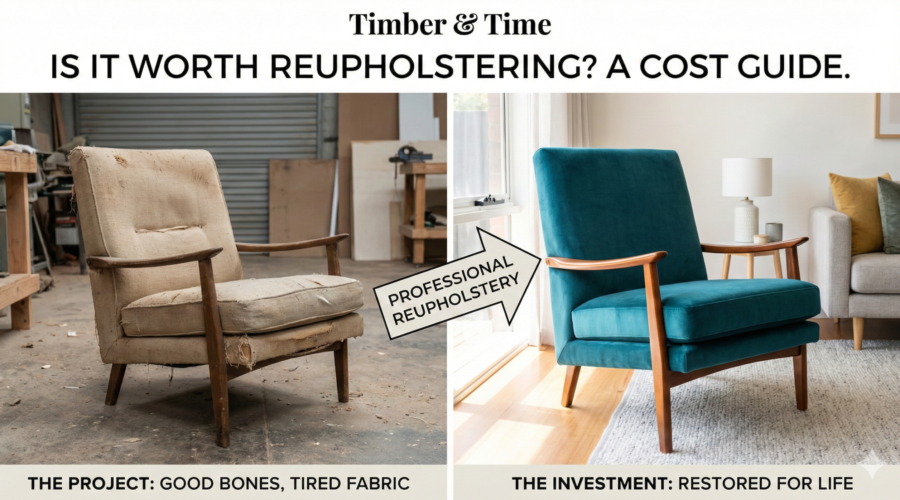
So, is it worth it? In 2026, the answer is almost always yes—provided the furniture has “good bones.”
Here is your honest, data-driven guide to the costs of reupholstery in Australia, and why it is still the smartest money you can spend on your home.
The Mindset Shift: You Aren’t “Fixing,” You Are “Customising”
Before we look at the numbers, we need to reframe what reupholstery actually is.
If you compare the cost of reupholstering a vintage 1960s armchair to buying a replica from Kmart, reupholstery loses every time.
But that’s the wrong comparison.
Reupholstering is the process of taking a high-quality, hardwood frame and rebuilding it from the inside out to your exact specifications. You choose the fabric, the foam density, and the detailing.
The correct comparison is: The cost of reupholstery vs. the cost of buying a brand-new, Australian-made, custom sofa. When you look at it that way, reupholstery is often 30–50% cheaper.
The 2026 Australian Cost Guide (Estimates)
Disclaimer: These prices are averages for labour and standard materials (foam/webbing) in Australian metro areas based on early 2026 trends. The cost of fabric is NOT included, as this varies wildly from $50/m to $300/m.
1. The Dining Chair (Slip Seat)
The Gateway Drug of upholstery. This is just the pad you sit on that unscrews from the frame.
- Labour Estimate: $150 – $250 per chair.
- Fabric Needed: approx. 0.7m per chair.
2. The Vintage Armchair (e.g., Mid-Century Parker/Fler)
These usually have exposed timber arms, meaning less fabric is required, but the shaping must be precise.
- Labour Estimate: $900 – $1,600.
- Fabric Needed: approx. 4m – 6m.
3. The Fully Upholstered Armchair (e.g., Wingback or Club Chair)
A complex job involving deep buttoning, piping, and complex curves.
- Labour Estimate: $1,400 – $2,200+.
- Fabric Needed: approx. 7m – 9m.
4. The 3-Seater Sofa (Standard)
The big job. This involves stripping the entire piece back to the bare frame.
- Labour Estimate: $2,500 – $4,500+.
- Fabric Needed: approx. 12m – 16m.
“Why Is It So Expensive?” Where Your Money Goes
When you pay $3,000 to reupholster a sofa, you aren’t just paying for new fabric. You are paying for dozens of hours of skilled, manual labour that cannot be automated by robots.
1. The Deconstruction (30% of the job)
An upholsterer doesn’t just staple new fabric over the old stuff. They have to painstakingly remove thousands of old staples and tacks by hand without damaging the timber frame. It is dirty, exhausting work.
2. The Frame & Innards Repair
Once stripped, they often find loose joints that need re-gluing, jute webbing that has sagged, or springs that need re-tying. They replace the old, crumbling foam with modern, high-density Dunlop foams that will last another 20 years.
3. The Patterning & Sewing
They use your old fabric pieces to create a pattern for the new fabric. Every panel must be cut precisely, matching patterns (like stripes or florals) perfectly across cushions.
4. The Rebuild
Only then does the new fabric go on. This requires immense hand strength and decades of experience to ensure tight corners, straight piping, and zero wrinkles.
The Decision Checklist: When to Save It vs. When to Bin It
How do you know if your sofa has the “good bones” designed to justify this cost?
✅ YES: Invest in Reupholstery If…
- It’s Heavy: Weight usually indicates a solid hardwood frame (like Tasmanian Oak or Jarrah) rather than chipboard or pine.
- It Has Provenance: It’s a known vintage brand (Parker, Chiswell, Tessa, Moran) or a high-quality reputable modern brand (Jardan, King Living).
- It holds sentimental value: You can’t put a price on the chair your grandfather sat in every night.
- It fits your space perfectly: Finding a new sofa with the exact right dimensions can be impossible.
❌ NO: Donate or Dispose If…
- You bought it cheaply in the last 10 years: If it cost $800 new, it likely has a stapled plywood or chipboard frame that won’t survive the stripping process.
- The frame is cracked or warped: Structural damage can be fixed, but it adds significantly to the cost.
- You just want a quick refresh: If you aren’t committed to the piece for the next 15 years, the investment isn’t worth it. Buy a throw blanket instead.
The Final Verdict
In 2026, reupholstery is an act of rebellion against disposable culture.
It’s a significant upfront cost, yes. But the result is a piece of furniture that is uniquely yours, built to a quality standard that is becoming terrifyingly rare, and saved from the landfill.
If you have a quality piece of furniture that needs a second life, don’t let sticker shock stop you.
Get a real quote from a master craftsman. Take a photo of your piece and send it to our network of verified Australian upholsterers today.
[Get a Reupholstery Quote Now]

Pingback: Best Auction Bazaars in Melbourne: Vintage Markets, Antique Stops and more - Timber & Time