Dining Table Size Guide: How Big Should Your Table Be for an Aussie Open-Plan Living Room?
The great Australian architectural dream: The open-plan living extension.
We love knocking down walls to create one vast, sunlit space where the kitchen flows into dining, and dining flows into the lounge (and usually out to the alfresco).
But this freedom creates a new problem. Without walls to guide you, how on earth do you know what size dining table to buy?
It’s the classic “Goldilocks” dilemma. Buy too small, and your table looks like dollhouse furniture lost in a cavernous room. Buy too big, and your beautiful open-plan flow turns into an obstacle course of bumped hips and squeezed chairs.
If you are investing in a quality custom or vintage piece from Timber & Time, you want to get it right the first time.
Forget the guesswork. Here is the definitive guide to calculating the perfect dining table size for your space.
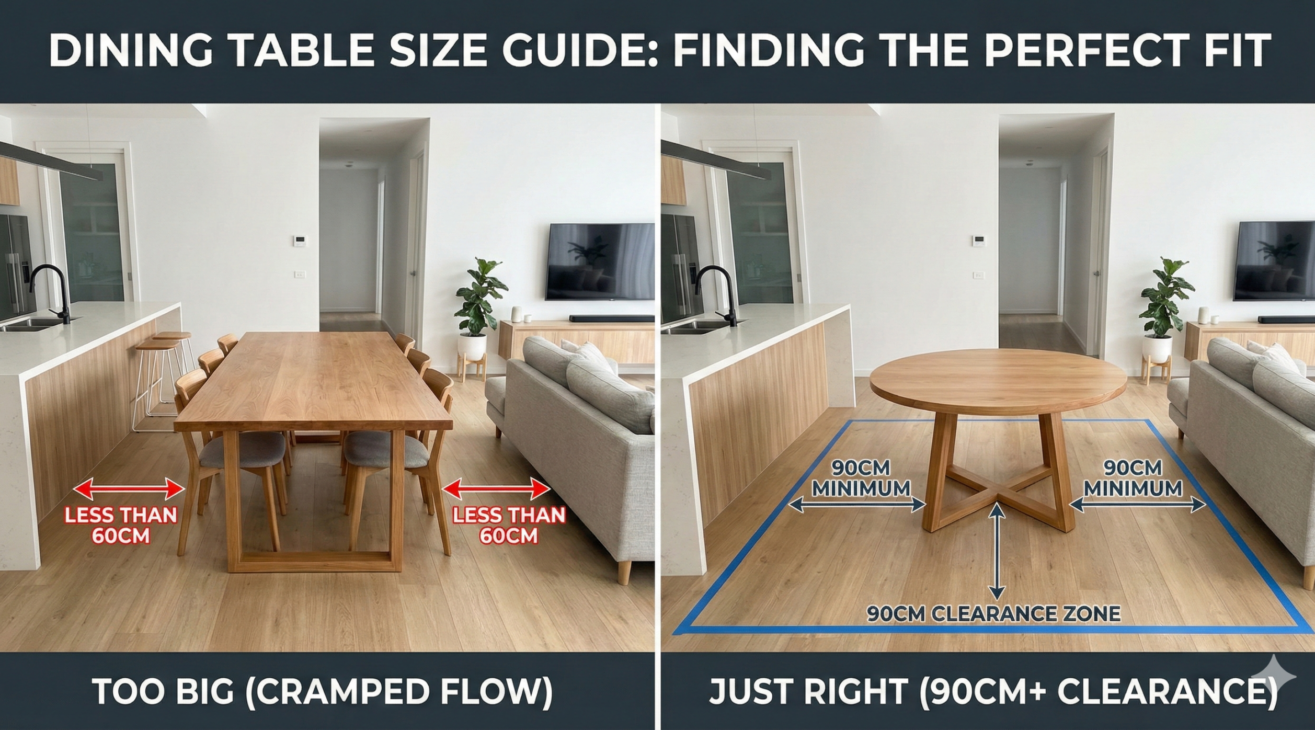
The Golden Rule: The “90cm Clearance Zone”
Before you even think about the table itself, you need to think about the empty space around it.
The most common mistake people make is measuring the room and thinking, “Great, a 3-metre table will physically fit.” They forget that people actually have to sit at it.
The Rule: You need a minimum of 90cm (900mm) clearance between the edge of your table and the nearest wall, sideboard, or kitchen island.
Why 90cm?
- You need roughly 60cm just to push your chair back and sit down comfortably.
- You need another 30cm for someone to walk behind you while you are seated.
The Exception: In high-traffic areas—like the main thoroughfare between the kitchen and the back door—try to increase this to 120cm.
The “Masking Tape Hack” (Do This Before Buying)
Don’t rely on your imagination. It will lie to you.
If you have your eye on a beautiful 2.4m Messmate table online, grab a roll of painter’s masking tape and mark that exact rectangle out on your floor.
Now, walk around it. Pull dining chairs from another room and place them within the tape. Open the doors of nearby cupboards.
Does it feel tight? If you have to turn sideways to shuffle past the imaginary table, it’s too big. Scale it down by 20cm and try again.
Sizing by Seating Numbers (The Cheat Sheet)
How many people do you need to seat daily? And how many for Christmas lunch?
Here are the standard Australian sizes for comfortable seating.
(Note: These are based on standard rectangular tables. If your chairs are extra wide, or have arms, you may need more length.)
- 4 Seater:
- Length: 120cm – 150cm
- Ideal for apartments or smaller breakfast nooks.
- 6 Seater (The Aussie Standard):
- Length: 180cm – 200cm
- The most common family size. Fits three chairs each side easily.
- 8 Seater (The Entertainer):
- Length: 220cm – 260cm
- Great for larger open-plan spaces. Often allows for a chair at each “head” of the table too.
- 10–12 Seater (The Statement Piece):
- Length: 280cm – 350cm+
- You rarely find these sizes in standard retail. This is where custom makers shine.
Shape Matters: Rectangular vs. Round vs. Oval
In an open-plan space, the shape of the table helps define the “zone.”
1. The Rectangle (The Anchor)
The classic choice. Its clean lines mimic the shape of most rooms, helping to clearly define the “dining zone” separate from the “lounge zone.”
- Best for: Long, narrow spaces or large families needing maximum seating.
2. The Round (The Flow Maker)
Round tables are fantastic for flow. Because there are no sharp corners, you can walk around them more easily, making them feel less intrusive in an open-plan area. They are also incredibly sociable.
- Best for: Squarer spaces, smaller apartments, or homes with lots of toddlers running around (no sharp corners!).
3. The Oval or “D-End” (The Hybrid)
Very popular in vintage mid-century design (think Parker extendable tables). You get the seating capacity of a rectangle with the softer, flowing edges of a round table.
- Best for: Narrow spaces where you need to squeeze past the corners.
The Final Word: When Standard Doesn’t Fit
You’ve done the masking tape test. You’ve measured the 90cm clearance.
And you realize your room needs a table that is exactly 215cm long and 105cm wide.
Good luck finding that in a big-box catalogue.
This is the beauty of the Timber & Time marketplace. If your open-plan space has tricky dimensions, don’t compromise. Connect with a custom maker who can build a table to your exact specifications, ensuring it fits your home like a glove.
Ready to find your perfect fit?
Explore our range of custom makers and vintage sellers today.
[Shop Dining Tables]